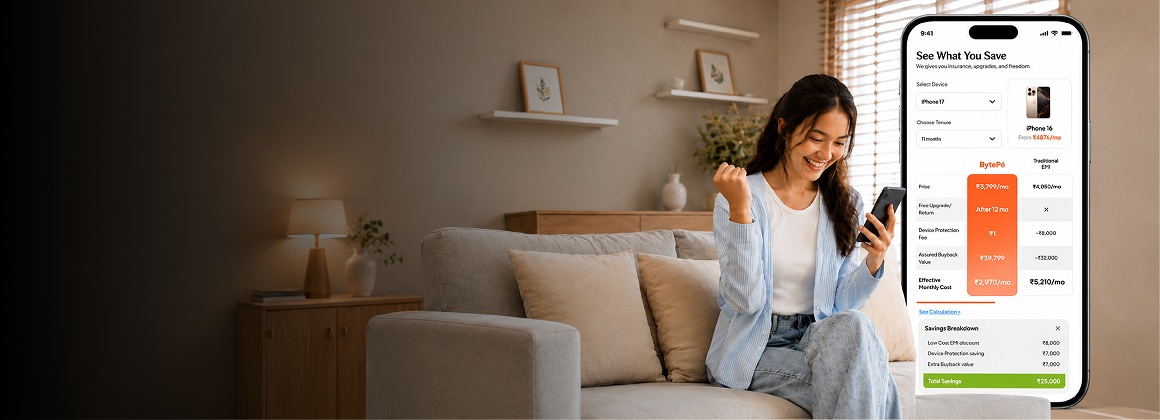
In India in 2026 there are three ways to get a phone: financing it on a store or card EMI (the Bajaj Finserv-style route most Indians use), buying outright, and a device subscription. Buying outright costs the least if you keep a phone for 3 or more years. A device subscription like BytePe, starting at ₹999 per month with damage protection and a yearly upgrade included, costs less over 12 to 24 months for anyone who upgrades often. A plain EMI feels light month to month, but you still commit to the full sticker price - and 'no-cost' EMI usually recovers its cost through a foregone discount or processing fee, with no upgrade or damage cover included.
| Option | Upfront Cost | Monthly Cost | Ownership | Flexibility | Upgrades | Best For |
|---|---|---|---|---|---|---|
| Store / Card EMI (Bajaj Finserv-style) | Low to none | Full price split into EMIs (interest or hidden charges on 'no-cost' plans) | Yours after the final EMI | Locked to the loan tenure; foreclosure charges to exit early | None built in - resell and refinance yourself | Spreading out a phone you'll keep 2-3 years |
| Buying Outright | High (full device price) | Lowest (SIM-only plan) | Full ownership + resale value | Complete freedom | Paid in full, each time | Keeping one phone 3+ years |
| Device Subscription (BytePe) | None | From ₹999 (device only, no carrier lock-in) | Subscribe, upgrade, return, or keep | Any SIM, any carrier | Yearly upgrade built in | Staying current without upfront cost |
The three models, and why people confuse them
Most advice on this topic treats "subscription" and "EMI" as the same thing. They are not, and the difference changes the maths.
A store or card EMI splits the phone's full price into monthly instalments, usually over 6 to 24 months - via a credit card, a cardless EMI card like Bajaj Finserv's, or checkout finance on Flipkart and Amazon. You are committing to the entire sticker price on day one; 'no-cost' EMI typically gives up the cash discount or adds processing fees, and closing the loan early attracts foreclosure charges. (Unlike the US, Indian telcos sell SIM-only plans - your phone and your network have always been separate purchases.)
A device subscription covers only the phone. You pay a monthly fee for the device itself and use any SIM from any carrier with it. BytePe, India's first technology subscription platform, works this way: plans start at ₹999 per month, every plan includes one-time 100% damage protection (a processing fee applies at claim time and one repair claim is allowed per device), and after the 12-month minimum lock-in you choose to upgrade, return for the assured buyback value, or pay to 24 months and own the phone. Your SIM stays your own decision throughout - phones in India are sold unlocked, and the subscription covers only the device.
Buying outright means paying the full retail price on day one. The phone is yours, you pick any SIM-only plan, and you keep the resale value when you eventually sell it.
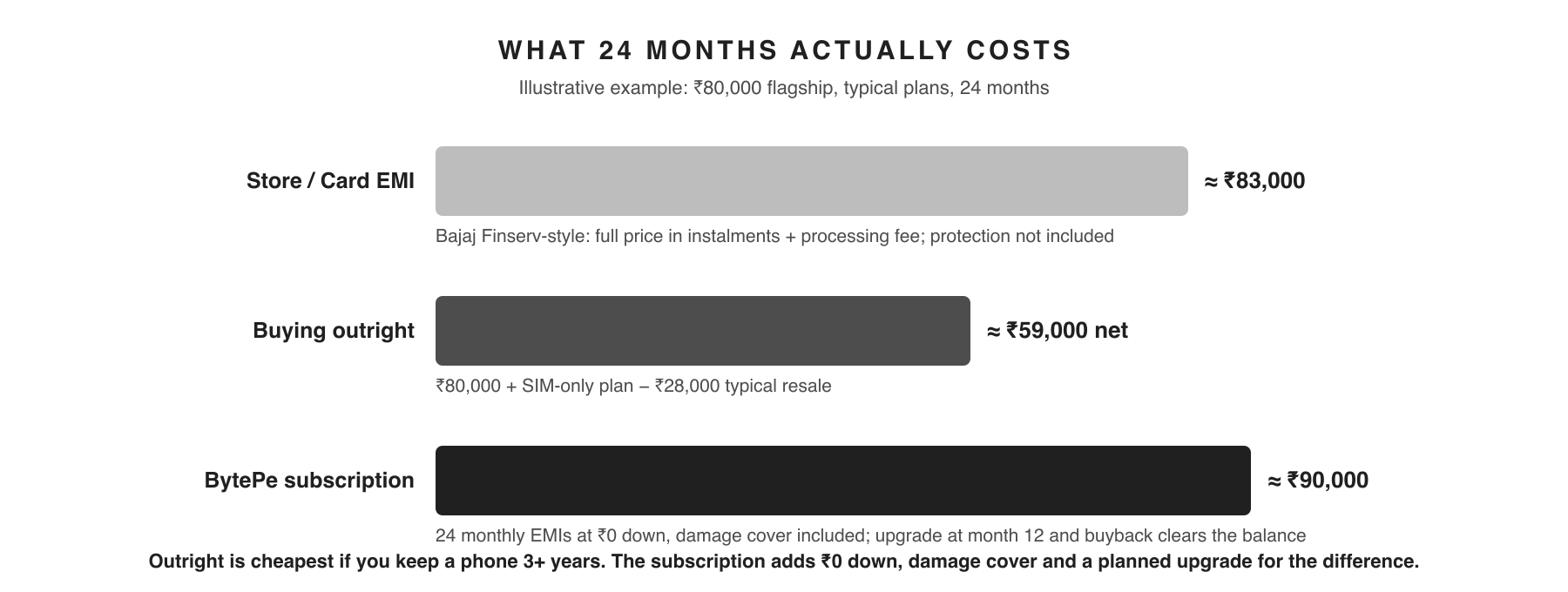
The cost maths over 24 months
Take a flagship priced at ₹80,000 and follow the money for two years.
Buying outright: ₹80,000 on day one, plus a SIM-only plan (₹200 to ₹400 a month). After two years you still own a phone you can sell; flagships commonly resell at 30 to 40% of launch price, so your net device cost lands near ₹50,000 to ₹56,000. Cheapest per rupee, but the ₹80,000 leaves your account before the phone leaves the box.
Store/card EMI: little or nothing upfront, but you finance the full ₹80,000. Interest-bearing EMIs end above sticker price; 'no-cost' EMIs usually cost you the cash discount plus processing fees. At month 24 you own a two-year-old phone, with no damage cover along the way and the resale hassle still ahead of you.
BytePe device subscription: ₹0 upfront, from ₹999 per month depending on the device, damage protection included, and an upgrade window at 12 months. Over 24 months you pay month by month instead of carrying an ₹80,000 hit on day one - with a 12-month minimum lock-in, after which you can return the phone for its assured buyback value instead of paying out the full tenure - and you skip both the resale hassle and the repair-bill risk. For anyone who would have upgraded at 12 to 18 months anyway, the subscription is the cheaper path to staying current.
The honest summary: outright wins if you hold a phone for three years or more and don't mind the upfront outlay. A device subscription wins if you upgrade often or want the flagship experience without the flagship cheque. A plain EMI sits in between: it solves the upfront-cash problem but leaves you with the full price, no protection, and no exit ramp.
Flexibility: the part the spreadsheet misses
An outright-purchased, unlocked phone gives you total freedom: any carrier, any plan, local SIMs when you travel, sell whenever you like. That freedom is real and worth paying for if you use it.
A device subscription keeps almost all of that freedom. Because BytePe subscriptions are not tied to any network, you keep choosing your own SIM-only plan and can switch carriers whenever a better tariff appears. What you add is an exit ramp the outright buyer doesn't have: at the end of the tenure you can hand the phone back and walk away, or take the newest model without selling anything.
A plain EMI is where flexibility quietly dies: the loan tenure decides your upgrade date, and foreclosure charges decide your exit fee.
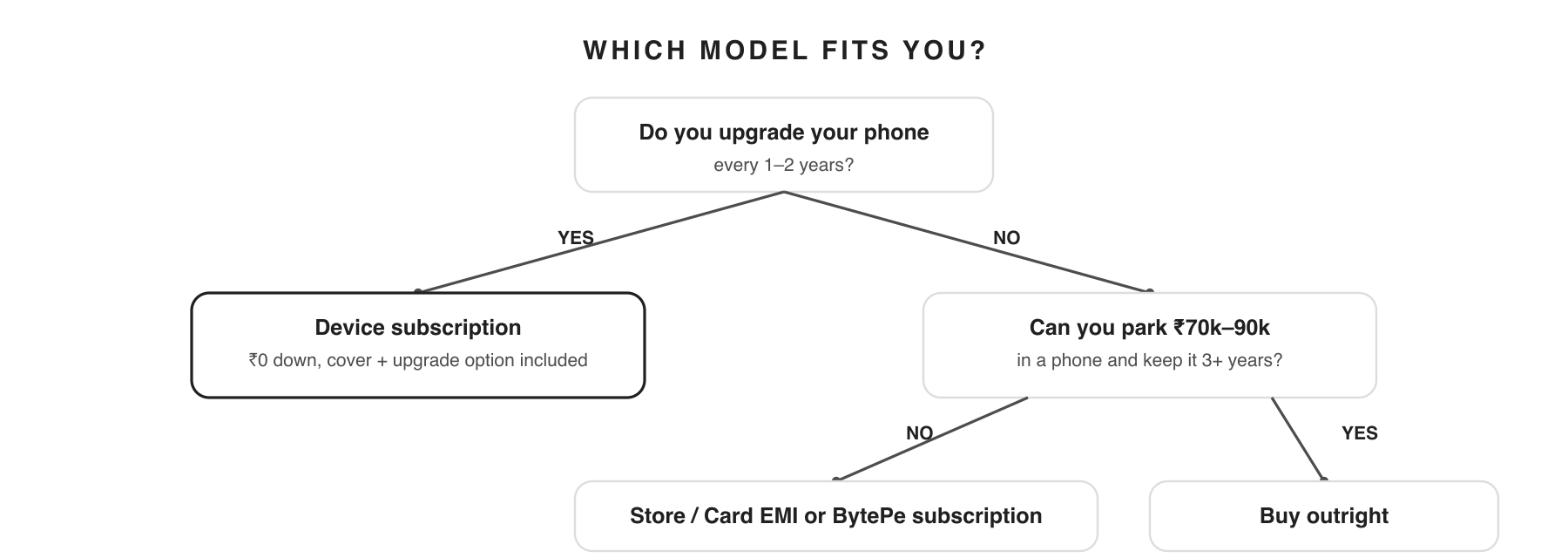
Which option is best for you? A verdict
There is no single winner; there is a right answer per person.
Buy outright if you have the capital ready, keep phones for 3+ years, and want maximum resale control. It is the lowest total cost for slow upgraders.
Take a device subscription if you upgrade every 1 to 2 years, want ₹0 upfront, or want damage protection bundled in. On BytePe's subscription plans you get the latest iPhone, Samsung, or OnePlus models from ₹999 per month with a yearly upgrade path, and you keep full carrier freedom throughout. If you prefer to end up owning the device from day one, BytePe's EMI store lets you buy on EMI, including cardless EMI plans for eligible customers.
Take a plain store/card EMI only if you are sure you'll keep the phone past the tenure - and read what the 'no-cost' actually costs before signing.
Whichever way you lean, run the 24-month maths on your actual usage before signing anything. If you're weighing your first subscription, our step-by-step guide on how to get the latest smartphone on subscription with BytePe walks through the process, and our guide to choosing mobile damage cover in India covers the protection side.
Is a phone subscription always more expensive than buying outright?
No. Over a typical 12 to 24 month cycle, a device subscription usually works out better value than a plain EMI - which finances the full price with no cover and no buyback - and cheaper than outright purchase for people who upgrade often. Outright purchase becomes the cheapest option only when you keep the phone for 3 or more years.
Do I need a credit card to get a phone subscription in India?
Not always. BytePe's standard subscription runs on credit-card EMI - the assured buyback is settled against your card outstanding after 12 months. If you don't have a credit card, eligible customers can choose a cardless EMI plan through BytePe's NBFC lending partner; eligibility is checked at purchase after standard KYC (Aadhaar and PAN).
What happens at the end of a phone subscription tenure?
On BytePe, after the 12-month minimum lock-in you choose one of three paths: upgrade to a newer model, return the device for its assured buyback value, or keep paying to the end of the 24-month tenure - after which the phone is fully yours.
Can I use any SIM with a subscribed phone?
Yes. A BytePe device subscription covers the phone only, so you pair it with any SIM-only plan from any carrier and can switch networks whenever you like. Phones in India are sold unlocked, so the device and the network are always separate decisions.
References & Links
Internal links
External references